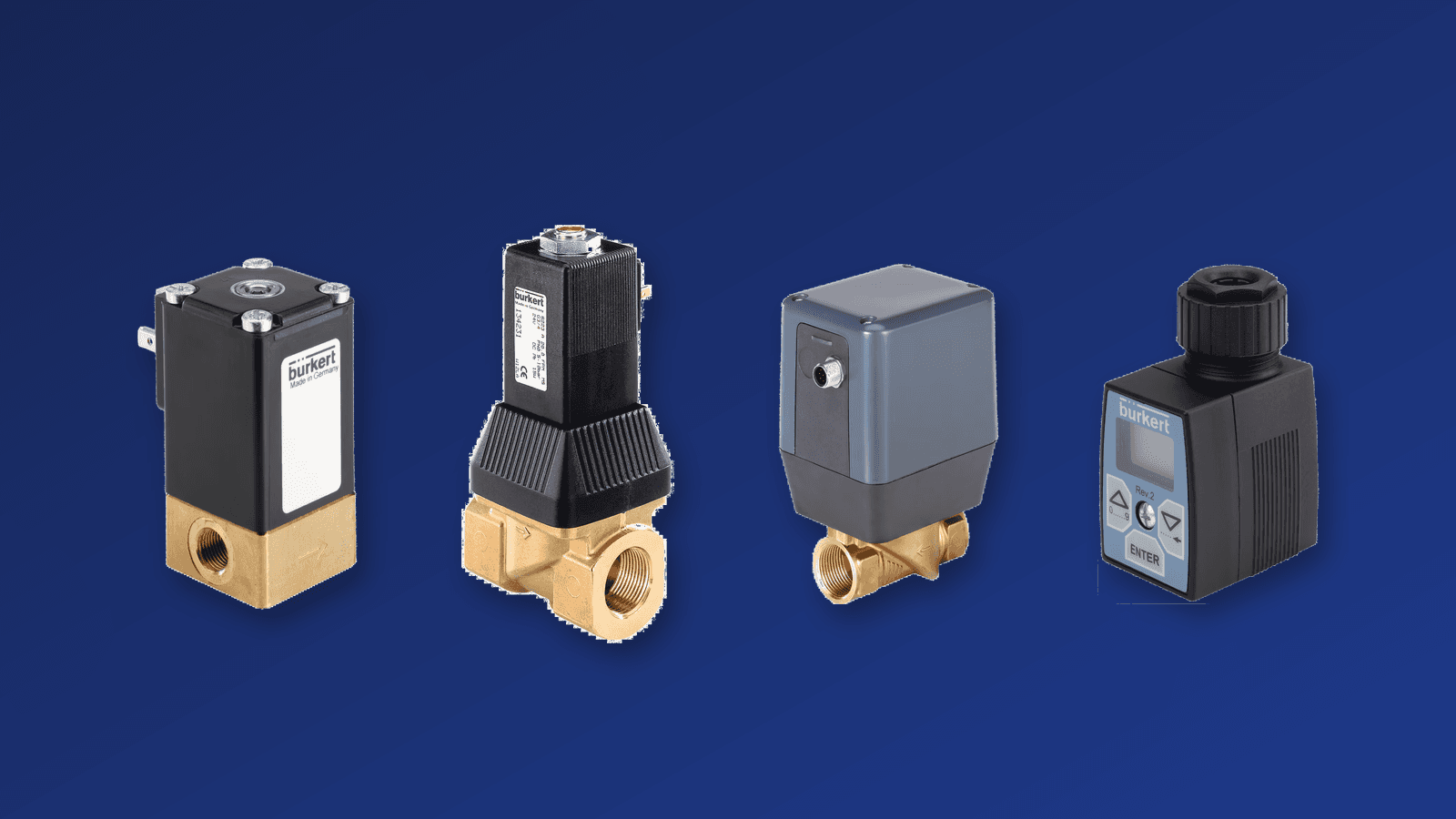
A proportional solenoid valve does something an ordinary solenoid valve cannot: it holds any position between closed and fully open, so flow can be set and trimmed continuously by a controller. That makes it the regulating element in compact flow, pressure and temperature loops, and the actuator inside most thermal mass flow controllers.
This guide explains how proportional solenoid control valves work and how to pick between Bürkert's direct-acting, servo-assisted and motor-driven designs, using Bürkert's published data for each type.
How a proportional solenoid valve works
In a proportional valve the magnetic force on the plunger is balanced against a spring. Increase the coil current and the plunger lifts further; reduce it and the valve closes. Because coil resistance changes as the coil warms up, proportional valves are normally driven by current-controlled electronics using a pulse-width modulated (PWM) signal rather than a plain voltage.
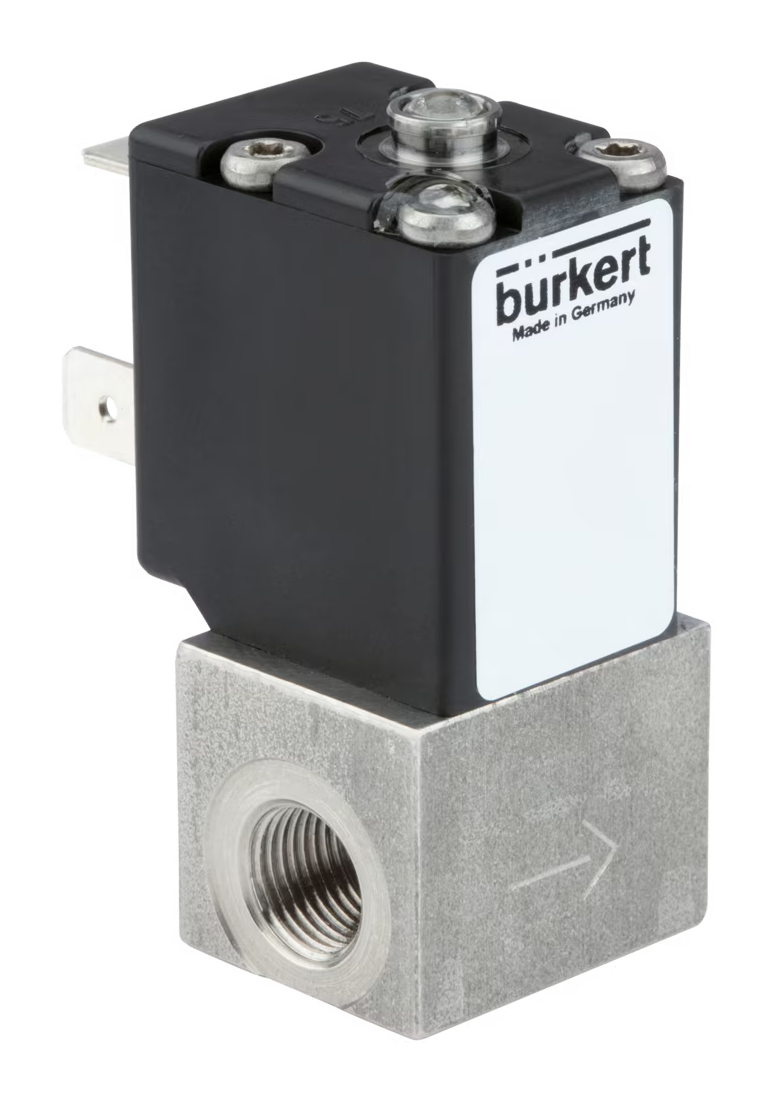
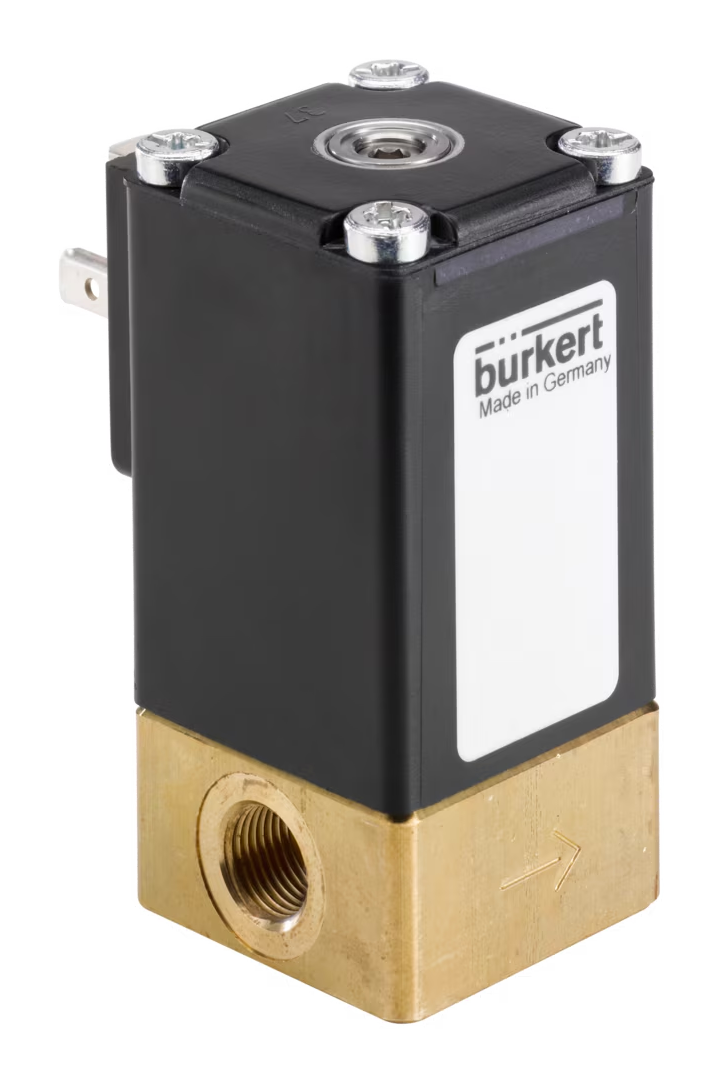
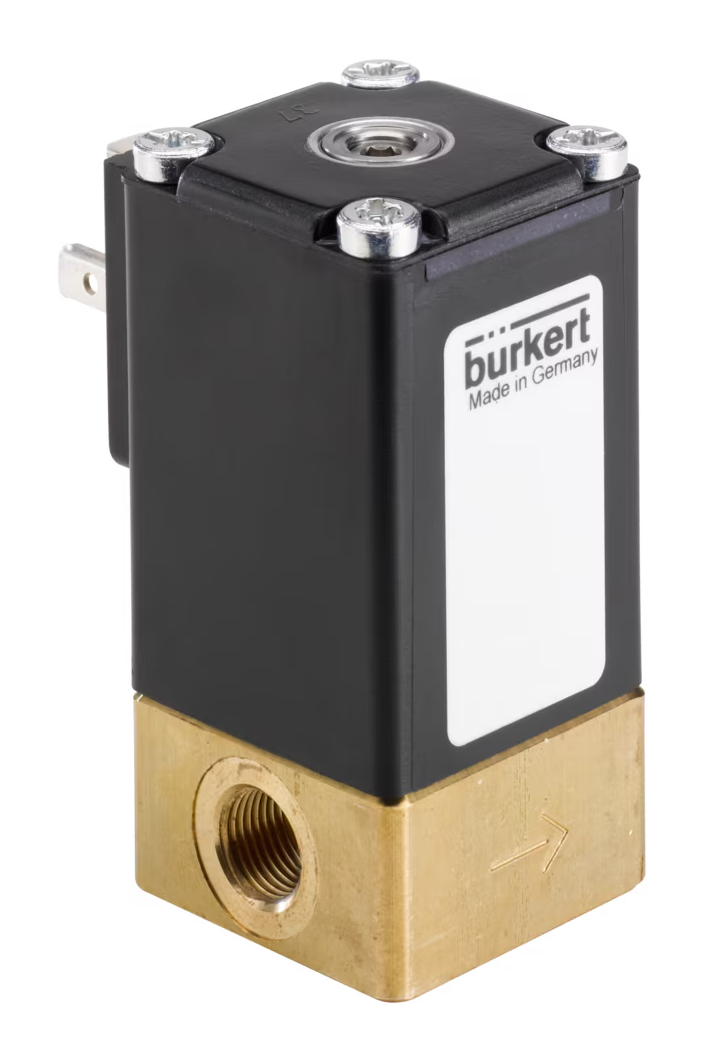
Bürkert's direct-acting standard proportional valves, the Type 2871, Type 2873 and Type 2875, use a frictionless plunger for very good response and an elastomeric seat seal that closes tight up to the nominal pressure, so the valve doubles as a shut-off valve.
Choosing by orifice and flow
| Bürkert type | Design | Published orifice or range | Typical use |
|---|---|---|---|
| 2871 | Direct-acting standard | 0.05 to 2.0 mm; 1/8" or sub-base | Very fine gas flows, high control range |
| 2873 | Direct-acting standard | 0.8 to 6 mm; Ex coil option | General gas and liquid control |
| 2875 | Direct-acting standard | 2 to 9.5 mm; Ex coil option | Higher flows |
| 2863 | Direct-acting basic | DN 0.8 to 4 mm | High-volume OEM loops |
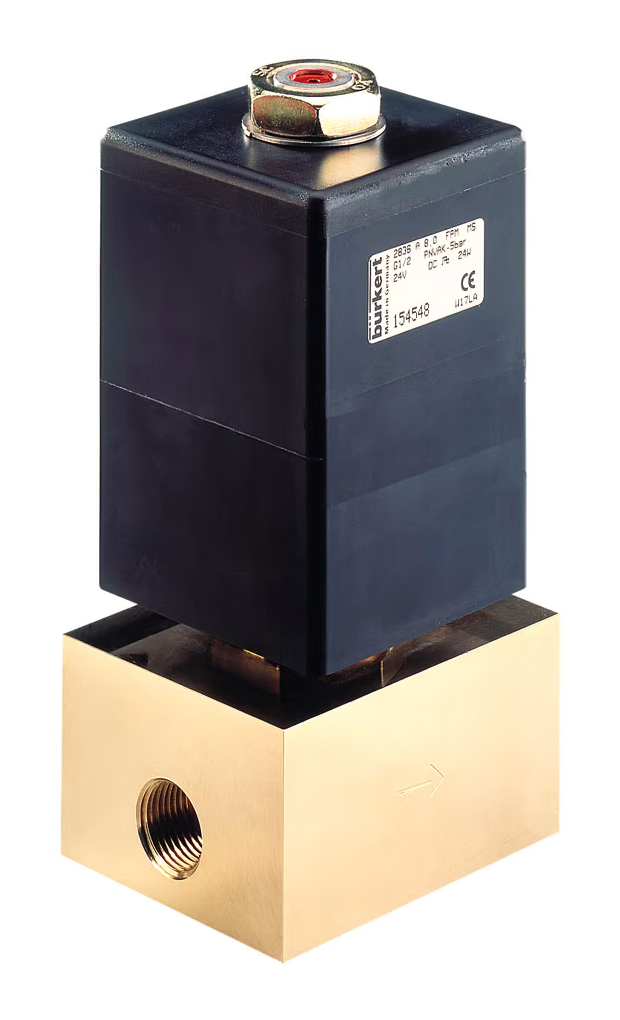
| 2836 | Direct-acting, NC | 3.0 to 12 mm; 0 to 25 bar | High flow rates |
| 6024 | Direct-acting, NC | 8 to 12 mm; 0 to 0.7 bar | High flow at low inlet pressure |
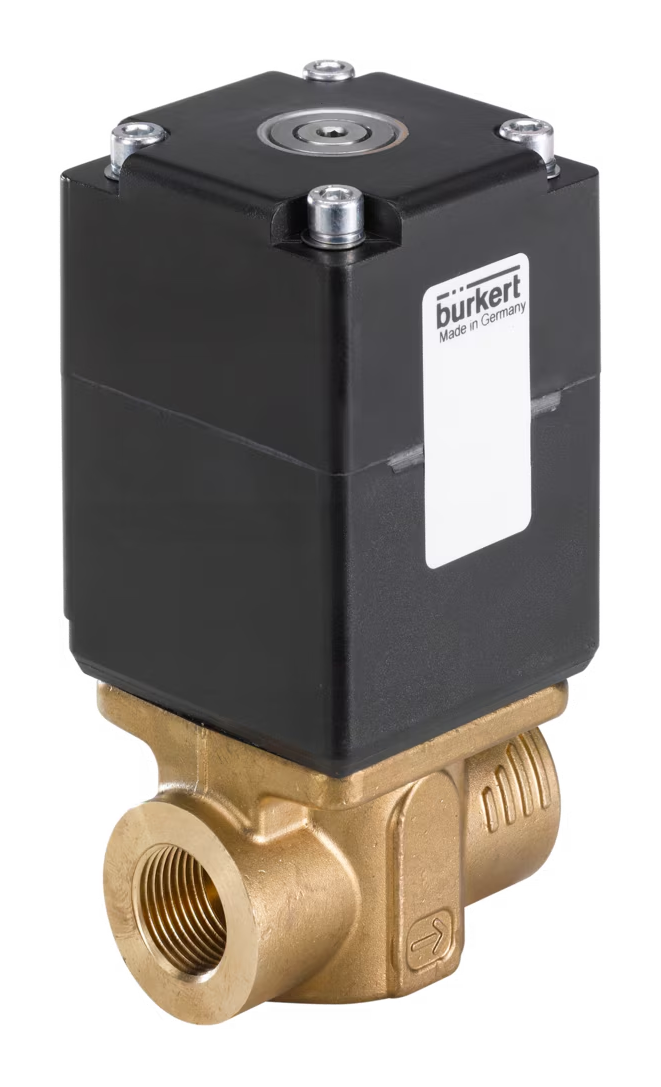
| 6223 | Servo-assisted | PWM control, tight closing | Larger liquid flows |
Start from the flow you need at the minimum available pressure, then pick the smallest orifice that delivers it with some margin. Oversizing a proportional valve wastes control resolution.
Low-pressure and high-flow duties
Gas burners and air systems often run at a few hundred millibar. The Type 6024 is a direct-acting proportional valve designed for relatively high flow rates at low operating pressures, 0 to 0.7 bar with 8 to 12 mm orifices. At the other end, the Type 2836 handles 0 to 25 bar with orifices up to 12 mm.
For larger liquid flows, the servo-assisted Type 6223 uses the medium to help open the valve while still offering low hysteresis, high repeatability and PWM control.
Why the drive electronics matter
A proportional valve is only as good as the current that drives it. The Bürkert Type 8605 control electronics convert a standard analogue signal into a PWM output from 40 to 2,000 mA, with internal current control so each input value maps to the same effective coil current regardless of coil temperature. Bürkert lists an adjustable PWM frequency, a display and keys for set-up, büS digital communication and an optional I/O board for external sensors or switches.
Motor-driven proportional valves
When energy use or holding position on power loss matters, a motor-driven valve is the alternative. The Type 3280 and Type 3285 are direct-acting globe valves driven by stepper motors with integrated electronics, so no separate controller is needed. The motor needs no energy to hold a position. Bürkert publishes DN 8 to DN 15 and Kvs 0.03 to 1.9 m³/h for the 3280 (with a high-pressure variant up to 22 bar), and DN 15 to DN 25 and Kvs 1.8 to 9.6 m³/h for the 3285. Both come as standard, positioner and process-controller variants.
Proportional valve or mass flow controller?
If what you really need is a controlled mass flow of gas, a complete mass flow controller with its own sensor and controller is usually simpler than building a loop from a proportional valve, a sensor and a PID controller. See our guide to mass flow controllers vs mass flow meters for the Bürkert Type 8741 to 8746 range.
Selection checklist
- Define the medium, the minimum and maximum flow, and the inlet and outlet pressure.
- Pick the design: direct-acting for gases and small flows, servo-assisted for larger liquid flows, motor-driven where hold-without-power or low energy matters.
- Size the orifice for the maximum flow at minimum pressure difference.
- Choose matching PWM electronics such as the 8605, or a motor valve with an integrated controller.
- Check explosion protection and connection options.
Territory Instruments can quote Bürkert proportional valves and drive electronics sized to your loop.
Frequently asked questions
What is the difference between a proportional valve and a solenoid valve?
A standard solenoid valve is either open or closed. A proportional solenoid valve can be held at any position in between, set by the coil current, so it can regulate flow or pressure continuously.
Why do proportional valves use PWM?
A PWM signal with current control keeps the effective coil current, and therefore the valve position, stable as the coil warms up. Bürkert's Type 8605 electronics do exactly this for proportional valves from 40 to 2,000 mA.
Do Bürkert proportional valves shut off tight?
Bürkert states that the 2871, 2873 and 2875 close tight up to the DN-specific nominal pressure thanks to an elastomeric seat seal, and that the 6223 closes tight.
When should I choose a motor-driven valve such as the 3280?
Choose a motor-driven valve when you want low power consumption, a valve that holds its position without energy, or integrated positioner and process controller functions. Bürkert publishes Kvs values from 0.03 to 1.9 m³/h for the 3280 and 1.8 to 9.6 m³/h for the 3285.